Salon, Spa and Studio Cleaning in Abbotsford, Langley and Surrey
Cleaned around your bookings rather than through them. Your team already spends eight hours a day inside the fumes of products they chose. The cleaning chemical is the one exposure in that room nobody asked for, and it is the one that is easiest to remove.
Salon and studio cleaning is a scheduled visit around your bookings, covering stations, backwash bowls, treatment rooms, studio floors, washrooms and laundry. Products are low-VOC and fragrance-free, because your staff already spend the day inside product fumes and the cleaning chemical is additive exposure on top of that.
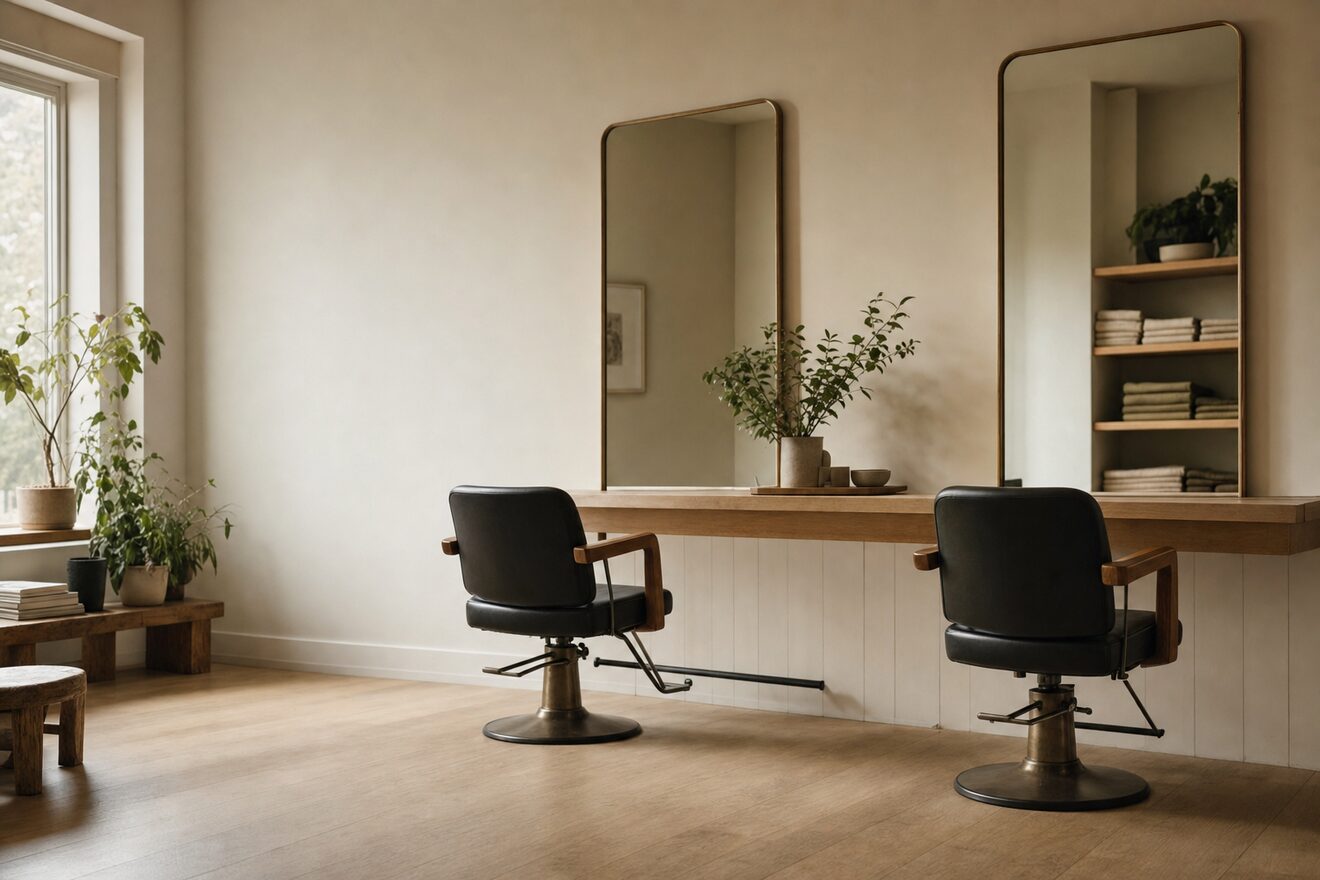
What does a salon or studio clean include?
Station by station. The boundary between our work and your regulated tool disinfection is written into the scope, in both directions.
-
Styling stations and mirrors
Every visit: station counters, the mirror in full and the frame, the shelf and the underside of the shelf, drawer fronts and handles, and the socket plates behind the station where product mist settles. Chair seat, back, arms, the hydraulic pump and the foot ring, which is the greasiest part of a salon and the least often touched. Trolley tops, sides and wheels. Dryer and processing units wiped down. Floor swept or vacuumed of hair first, then damp-mopped, including under and behind the chair bases rather than around them.
-
Backwash, colour bar and dispensary
Every visit: backwash bowls, the neck rest, the tap, the hose and the spray head, the bowl underside and the surround where colour splashes. Backwash chair frames and footrests. Colour bar counter, sink, bowl rack exterior, scales and the floor beneath. Colour staining on the floor and surround is treated as a stain, worked on mechanically rather than covered. We clean around your product, and we do not move, decant, top up or dispose of anything professional. A locked dispensary stays locked.
-
Nail, lash and brow stations
Every visit: table top, the arm rest and its underside, the lamp housing and switch, drawer fronts, the client and technician chairs including the arms, and the dust extraction unit exterior. Pedicure chair shell, footrest, jets housing exterior and the surround. Lash and brow beds: the vinyl in full, the frame, the headrest and the stool. Floors vacuumed for dust and filings, then damp-mopped. Implement disinfection is yours, on your own record, and we will say so every time we are asked.
-
Treatment rooms and studio floors
Every visit: massage and treatment table vinyl in full, including the face cradle, the frame, the height crank and the underside edge. Hot towel cabinet exterior, wax pot trolley and the floor around it. Trolleys, stools, shelving, door handles and light switches. Yoga and pilates studios: floor damp-mopped wall to wall, mirrors, wall bars, prop shelving, block and bolster surfaces, and the mat storage rack. Studio floors are done with plain detergent and rinsed, because a residue underfoot on a bare floor is felt immediately.
-
Washrooms, change area, reception and laundry
Every visit: washroom in full, with a disinfectant carrying an eight-digit Health Canada DIN on the toilet, the tap handles and the change table where fitted. Change cubicles, benches, hooks and mirrors. Lockers wiped, tops included. Reception desk, payment terminal, waiting seating and arms, retail shelving fronts and the glass at hand height. Laundry area: machine tops and fronts, the detergent shelf, the lint trap housing, the floor and the linen bin exterior. Bins emptied throughout, lids and pedals wiped.
-
Periodic work, and the reporting
Monthly: vents and diffusers dusted, high dusting on ledges, frames and light fittings, interior glass in full, skirting boards, and behind the backwash units. Quarterly: blinds, wall spot-washing at station height, and behind movable furniture. Every visit produces a timestamped photo report and a named cleaner, and a plugged backwash drain, a leak or a door left unlocked gets reported the same night.
How often does each area get done?
A starting grid. Chair count, treatment room count and how many days a week you are open move it, and the walkthrough is where it gets set.
| Area | Typical frequency | Whose job it is |
|---|---|---|
| Stations, chairs, mirrors, trolleys | Every visit | Ours |
| Backwash bowls, taps, surrounds | Every visit | Ours |
| Treatment tables and studio floors | Every visit | Ours, plus your between-client wipe-down |
| Washrooms and change area | Every visit | Ours. DIN-carrying disinfectant on the toilet and taps |
| Reception, retail shelving, entry glass | Every visit | Ours |
| Vents, high dusting, interior glass, skirting | Monthly | Ours |
| Blinds, wall spot-washing, behind furniture | Quarterly | Ours, booked on your quiet day |
| Combs, shears, implements, foot spa cycles | Between clients | Yours, on your regulated protocol and your log |
Your staff are already breathing something all day.
You already work all day inside other people’s product fumes. Adding a cleaning chemical on top of that is what tips a stylist into occupational asthma, and it is your staff who breathe it longest.
Start with what is well established, and note what it is not. We have no salon-specific exposure figures and we are not going to invent any. What exists is the general occupational literature, and it is consistent: the American Thoracic Society concluded roughly 15 per cent of adult asthma is work-related, later systematic analyses put the population-attributable fraction between 10 and 17.6 per cent, and CDC analysis across 22 states found 15.7 per cent of current asthma among ever-employed adults was work-related (Torén and Blanc, BMC Pulmonary Medicine; CDC, 2012). Cleaning is consistently among the highest-risk occupational groups in that literature. Give the range, not a single figure.
On the cleaning products specifically, Zock and colleagues followed 3,503 people across ten countries who did the cleaning in their own homes and were asthma-free at the start. Using cleaning sprays at least weekly carried a relative risk of incident asthma symptoms or medication of 1.49 (95% CI 1.12 to 1.99). Using sprays at least four days a week carried a relative risk of physician-diagnosed asthma of 2.11 (95% CI 1.15 to 3.89), with a dose-response for both frequency and number of different sprays. The authors estimated cleaning-product exposure could account for as much as 15 per cent, about one in seven, of adult asthma cases (AJRCCM, 2007). That is an association in an observational study, not a proven cause, and the participants were domestic cleaners rather than salon staff.
The genuinely useful part of that study is the format finding. The risk concentrated in spray products, because a trigger spray aerosolises the product straight into the breathing zone. Applying the same product to a cloth first and then wiping removes most of that exposure. It costs nothing, it is the practice we work to, and it is worth telling your own team about for the products they use all day.
Two more things a spa in particular should know. First, quaternary ammonium compounds, the quats in most commercial disinfectant wipes, demonstrably cause occupational asthma in some exposed individuals, confirmed by specific challenge testing (JACI: In Practice, 2021); the population-level magnitude is contested, and both halves belong in the sentence. Second, "naturally scented" is not a safety claim. Citrus and pine essential oils are terpene sources, and terpenes react with indoor ozone to form formaldehyde and ultrafine secondary organic aerosol, documented in chamber work at ozone levels as low as 17 to 21 parts per billion (Atmospheric Environment, 2008). Fragrance-free is a more defensible position than naturally scented, and in a treatment room it also stops the corridor arguing with room two.
The low-VOC products we use, named and linked to their safety data sheets. For the version to circulate to your team, see the safest cleaning products for asthma and what VOCs actually are.
What should a salon or studio expect to pay?
A fixed monthly figure against a written scope, quoted after a walkthrough. GST on top.
Salons are the sector where square footage tells you least. A six-chair salon with two backwash bowls is a different job from a six-hundred square foot lash studio with none.
What a walkthrough prices on: number of stations and chairs, backwash bowl count, whether there is a colour bar, how many treatment rooms and whether they involve wax, pedicure chairs, floor type and how much bare hard floor there is, washroom and change area count, whether there is on-site laundry, how many nights a week we come, and the hours we are allowed on site around the book. Hair volume on the floor is a real cost driver and it is the one most quotes forget.
We do not publish a per-square-foot number. Published Canadian guides put standard janitorial at $40 to $60 an hour, or $0.10 to $0.25 per square foot, while another puts a standard commercial clean at $0.30 to $0.60 per square foot. They disagree by roughly threefold, because they are measuring different frequencies and different task lists, most likely per visit against per month. Publishing a midpoint would be inventing a number to look confident. A twenty-minute walkthrough produces a real one.
If your space is really a small office or studio with no wet services, the office cleaning page is the simpler starting point.
What you get in writing, before you sign anything.
Including the boundary: what we clean, and what stays on your own regulated protocol.
-
Fixed monthly rate
Quoted after a walkthrough, not per hour, so your budget line does not move.
-
Photo report after every visit
Timestamped, so you can see the work was done without being on site.
-
A named substitute
Someone trained on your building covers holidays and sick days. The schedule does not lapse.
-
Proposal within 24 hours
After the walkthrough, in writing, with the product list attached.
-
Insurance certificate on request
Named to your building or your management company where you need it.
-
30 days notice, either way
No multi-year lock-in. If we are not doing the job, you should be able to leave.
Other buildings we clean: medical & dental clinics, daycares & preschools, strata & property management, offices & workplaces. Or start at commercial cleaning across the Fraser Valley, and see the contract mechanics on janitorial contracts.
Studios across the Valley.
Single studios, and small groups where the spaces sit close enough that one crew can hold the same standard across all of them.
- Cleaning in Abbotsford
- Cleaning in Langley
- Cleaning in Surrey
- Cleaning in Chilliwack
- Cleaning in Mission
- Cleaning in Maple Ridge
Hair and nail salons in Abbotsford and Langley, lash and brow studios in Surrey and Cloverdale, massage and spa rooms in Chilliwack, Mission and Maple Ridge, yoga and pilates spaces throughout, plus Aldergrove, South Surrey, White Rock, Delta and Pitt Meadows. All service areas.
What salon and studio owners ask.
Do you disinfect our tools, combs and implements?
No, and you should be wary of anyone who offers to. Implement and tool disinfection is regulated, it belongs to your practitioners, and it has to happen between clients rather than once at the end of the night. We clean the environment: stations, counters, chair bases, floors, bowls, trolleys and the washroom. Your tools stay on your protocol with your own registered product and your own record.
Will the cleaning smell fight with our products?
It should not smell of anything at all. Fragrance-free is our default, which matters more in a treatment room than almost anywhere: a client lies face down in a cradle for an hour with their nose about eight inches from a surface someone wiped last night. It also stops the odd result where a citrus cleaner in the corridor argues with the aromatherapy in room two.
When do you clean around a booking schedule?
After the last client or before the first, on the days you choose. Salons and studios have the least forgiving calendar of any sector we work in, because there is no dead hour: a gap in the book is somebody being paid to wait. We fit around it rather than through it, and if your quiet day is Tuesday then Tuesday is when the deeper periodic work lands.
Can you deal with hair, wax and colour on the floor?
Yes, and it is the part that separates a salon clean from an office clean. Floors are swept or vacuumed before anything wet touches them, because mopping over hair just moves it into the corners and the chair bases. Colour splash on the floor and the backwash surround is treated as a stain, not a smell. Wax on a floor or a trolley is lifted mechanically. What we do not do is strip and refinish a floor, which is a separate trade.
What about the dispensary and the colour bar?
We clean the counter, the sink, the bowl rack, the trolley and the floor. We do not move, decant, top up or dispose of your professional product, and we do not open a locked dispensary. Anything you want left untouched is written into the scope as untouched, which is a shorter conversation than discovering it afterwards.
Is ventilation part of this?
No, and it is worth saying plainly because the two get confused. Ventilation and local exhaust are building and HVAC questions, and they are the bigger lever on air quality in a nail or colour space than any cleaning product choice. What we control is the one exposure that is entirely optional: the cleaning chemical. We take that to fragrance-free and low-VOC, and we will not pretend that fixes your extraction.
Book a walkthrough.
Twenty minutes on site, on a quiet hour of your choosing. A written scope, the boundary with your own tool protocol set out in writing, and a fixed monthly price within 24 hours.
Request a studio walkthrough
We reply the same working day. Or call (819) 743-5953.