Strata and Common Area Cleaning in Langley, Surrey and Abbotsford
Lobbies, corridors, elevators, amenity rooms, gyms, parkades and garbage rooms, on a fixed monthly schedule with a photo report after every visit. A common area is shared air, and everybody in the building is breathing whatever the contract buys.
Strata cleaning is a fixed monthly contract covering lobbies, corridors, elevators, stairwells, amenity rooms, gyms, parkades, mail and garbage rooms. Products are fragrance-free by default, which removes the most common resident complaint before it reaches council. Every visit produces a timestamped photo report, so the manager can see the work without attending.
What does a common-area contract cover?
Area by area, with frequencies, because "common areas maintained" is what every losing proposal says. Yours becomes a written schedule and it is the document we get measured against.
-
Lobby, entry and mail room
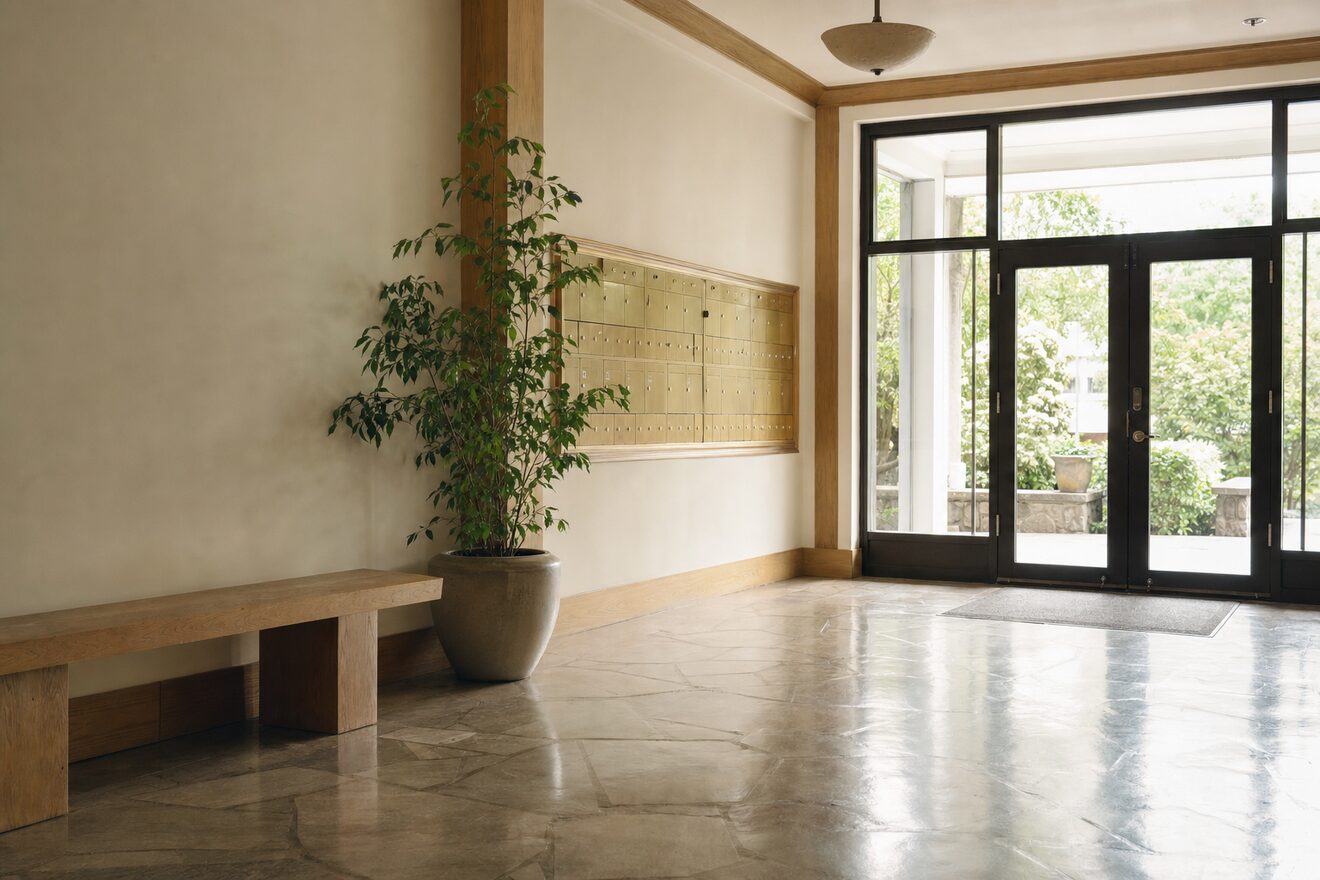
Every visit: entry glass on both faces at hand height, including the finger marks around the push plate, and the frames. Entry mats lifted, the floor beneath them washed, mats vacuumed on both sides. Hard floor damp-mopped with edges and corners done by hand. Front desk or concierge counter. Buzzer panel, fob reader and the door handles. Seating, including the arms and the underside of the arms. Mail room: parcel shelf, the tops of the mail banks, and the flyer recycling bin emptied, which is the thing residents notice most and complain about first. Cobwebs at the ceiling line and the light fitting bases.
-
Corridors, stairwells and elevators
Every visit: corridor carpet HEPA vacuumed wall to wall, not just the traffic lane, and hard corridor floors damp-mopped. Unit door handles and the door faces at hand height. Fire extinguisher cabinets, exit signage and the wall vents. Stairwells swept, the landings washed, and the handrails wiped top to bottom on both sides. Elevator cab: walls, mirror, handrail, the button panel on both floors and, crucially, the door tracks, which collect grit and are almost never done. Elevator lobby floors and the call button plate on every floor.
-
Amenity room, gym and guest suite
Every visit where these exist: gym equipment touchpoints, handles, grips, seat pads and screen bezels, plus the mirrors and the floor mats on both faces. Water fountain and bottle filler including the drain grille. Amenity room tables, chair arms, kitchenette counters and sink, fridge door and handle, and the bins. Guest suite on a turnover schedule you set rather than a fixed weekly one, because it is empty most of the time. Washrooms in these areas get the full washroom scope, including a disinfectant carrying a Health Canada DIN on the toilet and the tap handles.
-
Parkade, garbage and recycling rooms
Weekly for most buildings: garbage and recycling room floors washed, bin lids and grab handles wiped, the chute door and its handle, the wall at bin height, and the corridor approach that gets dragged through. Parkade: the elevator lobby and stair entry swept and cobwebbed, the fob reader, and the pedestrian route rather than the whole slab. What is not in a cleaning contract is pressure washing the parkade deck, moving bins for pickup, sorting a contaminated bin, or clearing an illegal furniture dump. Those are separate and they are written in as exclusions.
-
Periodic work, and the reporting
Monthly: corridor and lobby high dusting, ledges, frames, vents and diffusers, interior glass in full, skirting throughout, and the tops of the mail banks and fire cabinets. Quarterly: light fittings, blinds, stairwell walls spot-washed, and behind movable furniture. Every visit produces a timestamped photo report covering the same points each time, so month to month is comparable in a council package. Anything broken, leaking, propped open or left unlocked is reported the same day, because we are frequently the only person who walks the whole building.
How often does each area get done?
A starting grid for a mid-size building. Storey count, unit count, whether there is a gym and whether the parkade has pedestrian traffic all move it.
| Area | Typical frequency | Why that frequency |
|---|---|---|
| Lobby, entry glass, entry mats | Every visit, often 3 to 5 times a week | It is the first thing an owner, a buyer and a realtor sees, and in this climate it is wet nine months of the year. |
| Elevator cab, buttons, door tracks | Every visit | Highest touch surface in the building by a wide margin. |
| Corridors and stairwell handrails | Every visit for handrails, weekly for full corridor vacuum | Handrails are touch, carpet is soil. They do not need the same rhythm. |
| Amenity room, gym, common washrooms | Every visit where in use | Gym touchpoints and washrooms are where complaints start. |
| Garbage and recycling rooms | Weekly, or twice weekly on a chute building | Tied to your pickup schedule, so it lands after collection rather than before. |
| Parkade pedestrian routes | Weekly to monthly | Sweeping and cobwebs. Deck washing is a different trade. |
| High dusting, vents, full interior glass | Monthly | Corridor air is recirculated, and the dust above eye height is where a lot of it comes from. |
| Light fittings, blinds, behind furniture | Quarterly | Scheduled in advance so it can be named in the council minutes. |
A corridor is shared air, and one resident can occupy a whole meeting.
Common areas are shared air. One resident with a fragrance sensitivity can make a council meeting very long, and fragrance-free by default removes the complaint entirely.
The complaint is more common than most councils expect. Steinemann's cross-national population surveys found 32.2 per cent of adults report adverse health effects from fragranced consumer products, and, the number that matters in a corridor, 15.7 per cent report health problems from being in a room cleaned with scented products. Among people with asthma, 57.8 per cent report adverse effects from fragranced products. For about 9.5 per cent of the population the severity is described as disabling (Air Quality, Atmosphere and Health, 2019).
The caveat belongs in the same paragraph, not in a footnote: these are self-reported symptoms from population surveys rather than clinically confirmed diagnoses, and they come from a single research group. Read them as "roughly a third of adults report", not as a clinical prevalence. That is still enough to tell you what happens in a hundred-unit building. In a hundred units you are very likely to have the conversation, and it will happen at a council meeting rather than in an email.
There is a second reason, which is the building itself. A corridor has no openable window, and its air is recirculated. EPA's Total Exposure Assessment Methodology work found levels of about a dozen common organic pollutants to be two to five times higher inside than outside, regardless of location, with many VOCs consistently higher indoors (US EPA). And Health Canada's own Healthy Home Guide tells Canadians to minimise scented products because they can hide odours by producing VOCs, which can cause breathing problems, headaches, and irritation to the eyes, nose and throat (Health Canada). A lobby that smells strongly of anything is a lobby where something volatile was applied an hour ago.
So fragrance-free by default is not a premium option on our contract. It is the position that has no complaint attached to it, which for a property manager is worth more than a nice smell. See our fragrance-free default and the full product list, and the distinction councils always get wrong is covered in fragrance-free is not the same as unscented.
What a property manager actually needs in a bid.
Print this and hold every bid you receive against it, including ours. Most of what arrives fails on the first two lines.
-
A task list with a frequency beside every line
Not "common areas maintained". Every area, every task, and how often. If two bids do not list the same tasks, their prices are not comparable and the cheaper one is usually cheaper because it left the garbage room out.
-
A fixed monthly figure and the hours behind it
One number for the budget line, plus the hours on site per visit that produce it. Hours matter because they are the thing that quietly shrinks in year two while the invoice stays the same.
-
Written exclusions
Floor refinishing, pressure washing, window work at height, moss, duct cleaning, pest control, snow and biohazard. Named as exclusions in the document, so nobody discovers them at an AGM with sixty owners in the room.
-
Insurance and WorkSafeBC, verifiable
A liability certificate naming the strata corporation or the management company, and a WorkSafeBC clearance letter number you can check yourself at worksafebc.com. Ask every bidder. It takes a minute or two and it is the fastest way to shorten a shortlist.
-
Who holds a fob, and who covers a sick day
Named people, criminal record checked, and one named substitute already walked through the building. The most common failure in this industry is not bad cleaning, it is a visit that silently does not happen.
-
The product list, in a form you can circulate
Full list with safety data sheets, formatted so it can go in a newsletter, a lobby notice or an AGM package. Ten cleaning companies in this region claim eco-friendly. Not one of them names a product, which means no manager here can currently answer the fragrance question in writing.
More on separating bids in 11 questions to ask a cleaning company.
What should a strata expect to pay?
A fixed monthly figure against a written schedule, quoted after a walkthrough. GST on top.
The honest answer is that a common-area contract is priced on hours and frequency, and a per-square-foot number would tell you almost nothing about a building with two lifts and a parkade.
What a walkthrough prices on: number of storeys and units, how many visits a week, elevator count, whether corridors are carpet or hard floor, the number of common washrooms, whether there is a gym, an amenity room or a guest suite, garbage and recycling arrangement and whether it is a chute or a room, parkade pedestrian area, and how much exterior entry sits inside the scope. Two buildings of identical square footage can differ by half again on hours because one has three stairwells and a chute room.
We do not publish a per-square-foot rate, and the reason is useful in a bid comparison. Published Canadian guides put standard janitorial at $40 to $60 an hour, or $0.10 to $0.25 per square foot, while another puts a standard commercial clean at $0.30 to $0.60 per square foot. Those disagree by roughly threefold, because they are measuring different frequencies and different task lists, and most likely per visit against per month. If a bid you receive quotes a rate per square foot, the first question to ask is which of those two things it means. Ours is a scope and a monthly number, which is comparable to another scope and another monthly number.
What you get in writing, before you sign anything.
-
Fixed monthly rate
Quoted after a walkthrough, not per hour, so your budget line does not move.
-
Photo report after every visit
Timestamped, so you can see the work was done without being on site.
-
A named substitute
Someone trained on your building covers holidays and sick days. The schedule does not lapse.
-
Proposal within 24 hours
After the walkthrough, in writing, with the product list attached.
-
Insurance certificate on request
Named to your building or your management company where you need it.
-
30 days notice, either way
No multi-year lock-in. If we are not doing the job, you should be able to leave.
Other buildings we clean: medical & dental clinics, daycares & preschools, salons, spas & studios, offices & workplaces. Or start at commercial cleaning across the Fraser Valley, and see the contract mechanics on janitorial contracts.
Buildings across the Valley.
We take multi-building rounds where the sites sit close enough together that one crew can hold the same standard across all of them, which is how a management portfolio should be priced.
- Cleaning in Abbotsford
- Cleaning in Langley
- Cleaning in Surrey
- Cleaning in Chilliwack
- Cleaning in Mission
- Cleaning in Maple Ridge
Stratas and rental buildings in Langley, Surrey and Abbotsford, plus Chilliwack, Mission, Maple Ridge, Aldergrove, Cloverdale, South Surrey, White Rock, Delta and Pitt Meadows. All service areas.
What councils and property managers ask.
Can the insurance certificate name our strata corporation?
Yes. Tell us the exact legal name of the strata corporation, or of the management company, and we name it on the certificate and send it with the proposal rather than after you have signed. We also give you the WorkSafeBC clearance letter number so you can verify coverage yourself, free, rather than take our word for it. In BC this is not paperwork for its own sake: if uncovered workers are injured on your common property, the compensation exposure can land on the owners.
A resident has a fragrance sensitivity. What do we tell them?
Tell them the corridor is cleaned fragrance-free by default and hand them the product list. That is the whole answer, and it ends the item on the agenda. Fragrance-free is not an upgrade we charge for and it is not a request you have to remember to make. If a council later decides it wants a scent in the lobby, that is a decision council can make in writing, and we will still tell you what is in it.
How do we know the work was done if nobody is there at 7am?
A timestamped photo report after every visit, covering the same set of points each time so month to month is comparable. That is the single most useful thing a manager can put in a council package, because it turns a line item into evidence. It also settles the common dispute in reverse: when a resident says the lobby was not done on Tuesday, you can look.
What is not included in a common-area contract?
Written in as exclusions so nothing surfaces at an AGM. No floor stripping, sealing, waxing or burnishing, which is a separate trade and the most solvent-heavy job in commercial cleaning. No pressure washing of parkades or walkways, no roof and siding moss, no window work needing a lift or rope access, no duct cleaning, no pest control, no snow clearing, and no biohazard or needle pickup, which needs certified remediation we do not hold. See everything we decline and who to call instead.
Do you handle garbage and recycling rooms?
Yes, and it is usually the part of the building a council is most tired of. Floors washed, bin lids and handles wiped, the chute door and its handle, the walls at bin height, cobwebs, and the corridor approach that gets dragged through. What we do not do is sort a contaminated bin, move a bin for pickup, or deal with an illegal dump of furniture, because those are the building manager or the hauler, and a cleaning contract that quietly absorbs them stops being a fixed price.
Are we locked in, and what happens at renewal?
Thirty days notice either direction, no multi-year term. If a fixed term suits your budget cycle or your AGM we will sign one, but it is not our default and it is not a condition of the price. A company that needs a long contract to keep a strata is telling you something about how the second year usually goes.
Book a walkthrough.
We walk the building with you or with the caretaker, write the schedule area by area, and send a fixed monthly price within 24 hours with the product list and the insurance certificate attached. It is written to be forwarded to a council.
Request a building walkthrough
We reply the same working day. Or call (819) 743-5953.