Office and Workplace Cleaning in Surrey, Langley and Abbotsford
A modern office is a sealed box that recirculates its own air for eight hours. Nobody sitting in it chose what gets sprayed in it, and most of them could not tell you the name of a single product. That is the argument, and it is stronger at work than at home.
Office cleaning here is a fixed monthly contract, worked evenings or early mornings so nobody is sitting in the room. It covers workstations, meeting rooms, kitchens, washrooms, floors and every high-touch surface between them, with low-VOC products and a published list your staff can read.
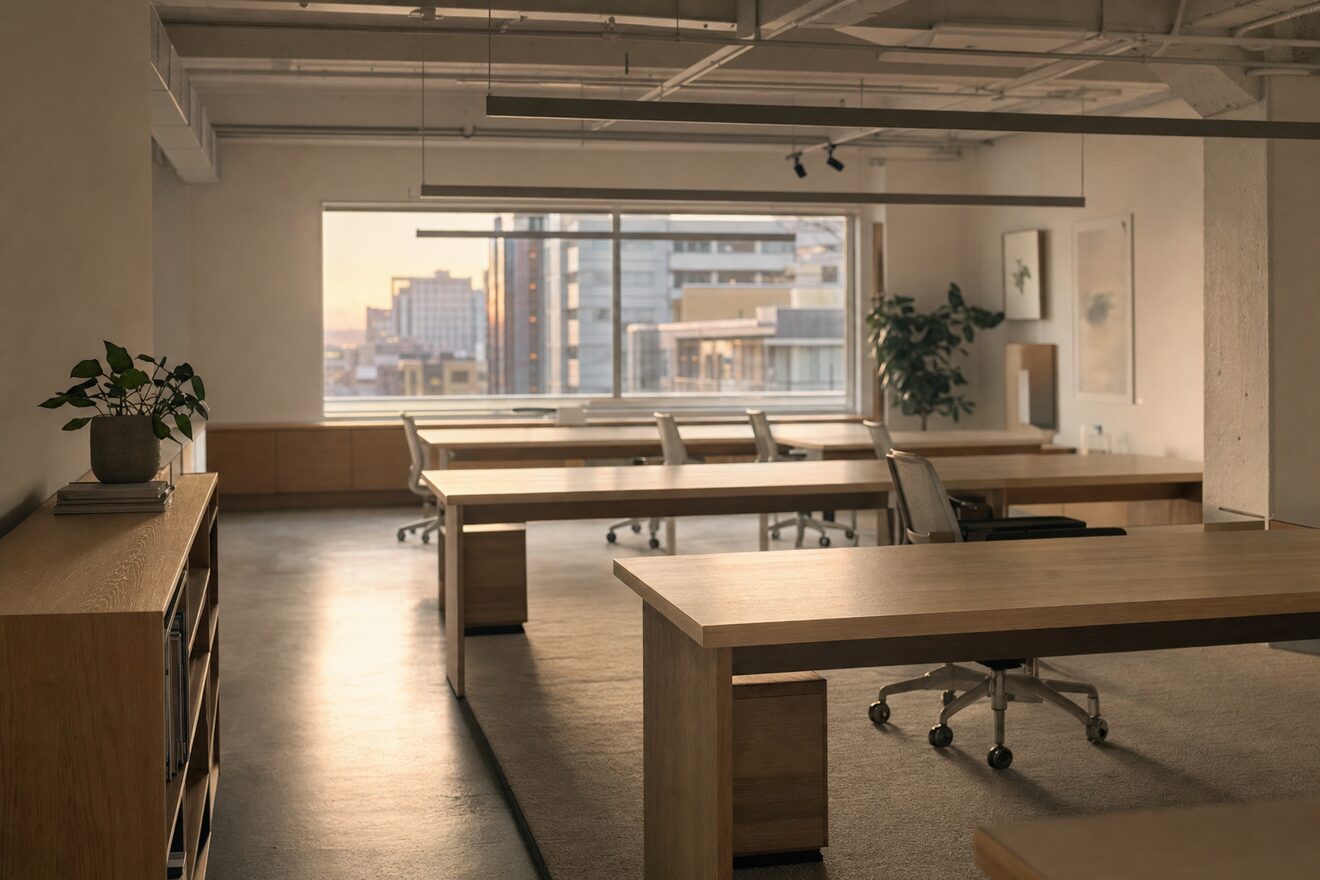
What does a workplace contract cover?
By workplace type, because a showroom and a warehouse lunchroom have almost nothing in common. For the standard room-by-room office specification, the office cleaning page has it in full.
-
Open plan and workstations
Every visit: desks wiped around whatever is left out, because we do not move papers or lift a laptop. Monitor bezels, keyboards, mice and phone handsets. Chair arms, bases and the height lever. Desk dividers and the acoustic panels at hand height. Filing cabinet tops, window ledges and heater tops. Glass partitions cleaned at hand height, where the marks are, and the door edge finger marks that everyone else leaves. Bins emptied at every desk, liners replaced, and recycling and organics separated into the building stream. Floors HEPA vacuumed including under the desks, hard floors damp-mopped, entrance mats lifted and the floor beneath cleaned.
-
Meeting rooms, boardroom and reception
Every visit: boardroom table top and edge, chair arms, the glass in full including the door push area, whiteboard trays and the marker ledge, remote controls, conference phones and the table power grommets. Reception desk on both faces, the visitor book or tablet, the seating and its arms, and the exterior entry glass and handles. Then the high-touch list that matters most for illness transmission and is most often skipped: light switches, door handles and push plates, stair rails, elevator buttons, kettle and fridge handles, and the photocopier lid and start panel. Every visit, no exceptions.
-
Kitchen, staff room and washrooms
Every visit: counters, sink, taps and the drain. Fridge exterior and door handle, interior monthly or on request. Microwave inside and out. Coffee machine drip tray, kettle base, toaster crumb tray. Cupboard fronts, table and chair rungs, and the bin lid handle, which is the dirtiest surface in most offices and the least often touched by a cleaner. Washrooms in full: toilets and urinals inside and out including the hinges and the wall behind, partitions on both faces, sinks, taps, basin undersides, mirrors, dispenser bodies refilled from your stock, and the floor washed by hand along the skirting. A disinfectant carrying an eight-digit Health Canada DIN goes on the toilet and the tap handles.
-
Showrooms, studios and customer-facing space
Every visit: display surfaces, plinths and shelving fronts, the glass in full because a showroom is judged on glass, product surfaces where you allow us to touch them, the counter and the payment terminal, and the floor edge to edge rather than the traffic lane. Fitting rooms, mirrors, benches and hooks where relevant. Entry mats lifted, the floor under them washed, and cobwebs at the ceiling line, which are visible to a customer and invisible to everyone who works there.
-
Light industrial and warehouse
Every visit or on an agreed rhythm: lunchroom and washrooms in full, site office, stair rails and the mezzanine landing, the shipping counter, door push plates and the pedestrian route through. Hard floors on an agreed machine schedule rather than a nightly one. What sits outside a cleaning contract: production equipment, spill response, anything requiring lockout, work at height, and anything inside a marked hazard zone. Those go in the document as exclusions rather than being discovered later.
-
Periodic work, and the reporting
Monthly: vents and diffusers dusted, high dusting on ledges, frames and light fittings, interior glass in full, skirting boards, and under and behind the desk banks. Quarterly: blinds, chair fabric spot-treated, and behind movable furniture and storage. Every visit produces a timestamped photo report and a named cleaner rather than a rotating stranger. Consumables are flagged before they run out, and anything broken, leaking or left unlocked is reported the same night, because we are usually the last people in the building.
How often does each zone get done?
A starting grid for a single-tenant office. Headcount matters far less than washroom count and floor type, which surprises most people.
| Zone | Typical frequency | What drives the frequency |
|---|---|---|
| Washrooms and kitchen | Every visit, usually the reason you need 5 nights rather than 2 | Fixture count and headcount together, not floor area. |
| High-touch surfaces | Every visit | Switches, handles, rails, buttons, copier panels. The cheapest part of the scope and the first thing dropped by a company under-pricing a bid. |
| Desks, bins, floors | Every visit | Bins are daily in a building with food at desks, whatever the vacuum schedule. |
| Meeting rooms and reception glass | Every visit | Reception is the room your clients judge you in. |
| Full carpet vacuum, edge to edge | Weekly, with traffic lanes every visit | Under-desk vacuuming is what separates a real scope from a walk-through with a vacuum. |
| Vents, high dusting, interior glass, skirting | Monthly | Sealed buildings recirculate their dust. This is the part that actually affects the air. |
| Blinds, chair fabric, behind furniture | Quarterly | Booked in advance so it lands on a quiet week. |
| Floor refinishing, carpet extraction, high windows | Never, by design | Separate trades. Named as exclusions so no one is surprised. |
Indoor air is not a smaller version of outdoor air.
A sealed office recirculates its own air all day. Nobody sitting in it chose the products, and low-VOC cleaning is one of the few air-quality levers a tenant actually controls.
Start with the baseline, because most people have it backwards. EPA's Total Exposure Assessment Methodology work found levels of about a dozen common organic pollutants to be two to five times higher inside buildings than outside, regardless of whether the location was rural or industrial, with many VOCs consistently higher indoors and some up to ten times higher. There are no federally enforceable VOC standards for non-industrial indoor settings in the United States, and Canada likewise has guidance rather than enforceable limits (US EPA). Nobody is going to regulate what is sprayed in your office. The lease does not cover it and neither does the building code.
The scale of it is larger than the intuition suggests. McDonald and colleagues, writing in Science in 2018, found that volatile chemical products, a category that includes coatings, inks, adhesives, personal-care products and cleaning agents, now make up roughly half of fossil-fuel VOC emissions in industrialised cities, because transport emissions have fallen so far. For particle-forming emissions specifically, chemical products contribute about twice as much as the transportation sector (Science, 2018).
Then the two studies that get quoted badly everywhere, quoted properly here. Svanes and colleagues, 2018: 6,235 participants from the European Community Respiratory Health Survey, mean age 34 at enrolment, followed for more than twenty years with repeated spirometry. In women, compared with women not doing cleaning, those cleaning at home lost FEV1 3.6 mL a year faster and FVC 4.3 mL a year faster; women working as occupational cleaners lost FEV1 3.9 mL a year faster and FVC 7.1 mL a year faster. The authors themselves described the accelerated decline in occupational cleaners as comparable to smoking somewhat less than 20 pack-years. No association was found in men, which the authors attribute partly to the very small number of male professional cleaners in the cohort (AJRCCM, 2018).
Read that carefully, because the headline version is wrong. It is an observational cohort, not a trial: it shows association over two decades, not proof of cause. The smoking line is the authors' own comparison, and it describes people who cleaned for a living for twenty-plus years. It does not describe someone wiping a counter, and anyone telling you cleaning products are as bad as smoking is selling something. The finding is also, uncomfortably for us, about the people doing the cleaning. In a commercial building that is our staff before it is yours, which is why this is an operating decision here rather than a marketing position.
Zock and colleagues, 2007, followed 3,503 people across ten countries who did the cleaning in their own homes and were asthma-free at the start. Using cleaning sprays at least weekly carried a relative risk for incident asthma symptoms or medication of 1.49 (95% CI 1.12 to 1.99); at least four days a week, the relative risk of physician-diagnosed asthma was 2.11 (95% CI 1.15 to 3.89), with a dose-response for both frequency and number of different sprays, concentrated in glass-cleaning, furniture and air-freshening sprays (AJRCCM, 2007). The practical finding inside it is the format: a trigger spray puts the product into the breathing zone. Applying it to a cloth first removes most of that exposure, and it costs nothing. That is how we work, and it is worth telling whoever keeps a spray bottle under the office sink.
Our green cleaning approach, named product by product, circulate it to whoever asks. Also what VOCs actually are and whether to worry, and what office cleaning should cost in Surrey and Langley.
What should an office expect to pay?
A fixed monthly figure against a written scope, quoted after a walkthrough. GST on top.
Headcount is the number everybody offers first and it is close to useless. Washrooms, fixtures, floor type and frequency do most of the work.
What a walkthrough prices on: total square footage, the number of washrooms and fixtures in them, the carpet-to-hard-floor split, how many nights a week we come, whether there is a real kitchen with real dishes, how many separate meeting rooms and how much glass, whether the building has its own waste sorting rules, whether there is a showroom or a warehouse component, and the hours we are allowed on site. A 1,200 square foot studio with one washroom and a 4,000 square foot office with four are different businesses.
We do not publish a per-square-foot number, and the disagreement in the published numbers is the reason, not an excuse. Canadian guides put standard janitorial at $40 to $60 an hour, or $0.10 to $0.25 per square foot, while another puts a standard commercial clean at $0.30 to $0.60 per square foot. That is a threefold gap, and it exists because the two are measuring different frequencies and different task lists, most likely per visit against per month. When you compare bids, the first question is which of those two things the rate means, and the second is what task list sits under it. A 3,000 square foot office cleaned weekly is commonly cited at $550 to $650 a visit. Ours will be a real quote against a written scope, not a range.
The single-site version of this service, with the full room-by-room specification and the exclusions, is on the office cleaning page, and the contract mechanics are on janitorial contracts.
What you get in writing, before you sign anything.
-
Fixed monthly rate
Quoted after a walkthrough, not per hour, so your budget line does not move.
-
Photo report after every visit
Timestamped, so you can see the work was done without being on site.
-
A named substitute
Someone trained on your building covers holidays and sick days. The schedule does not lapse.
-
Proposal within 24 hours
After the walkthrough, in writing, with the product list attached.
-
Insurance certificate on request
Named to your building or your management company where you need it.
-
30 days notice, either way
No multi-year lock-in. If we are not doing the job, you should be able to leave.
Other buildings we clean: medical & dental clinics, daycares & preschools, strata & property management, salons, spas & studios. Or start at commercial cleaning across the Fraser Valley.
Workplaces across the Valley.
Single sites, and multi-site schedules where the buildings sit close enough that one crew can hold the standard across all of them.
- Cleaning in Abbotsford
- Cleaning in Langley
- Cleaning in Surrey
- Cleaning in Chilliwack
- Cleaning in Mission
- Cleaning in Maple Ridge
Offices in Surrey, Langley and Abbotsford, showrooms and studios in Cloverdale and Maple Ridge, light industrial in Chilliwack and Mission, plus Aldergrove, South Surrey, White Rock, Delta and Pitt Meadows. All service areas.
What office managers ask first.
We lease one floor of a bigger building. Does that change anything?
It changes the boundary rather than the work. Your landlord almost certainly holds a contract for the lobby, the elevators and often the shared washrooms, and you hold the demised premises. We scope only what is yours and write the line into the document, because the two most common problems in a multi-tenant building are a task that both contractors think the other is doing and a task neither is. If you also manage the common areas, that is the strata and common area page.
Can you clean during the day instead?
For a warehouse, a showroom or a studio, often yes and it works well. For a sealed office with people at desks it is the worst option available. Even low-VOC products are best applied to a room nobody is sitting in, a vacuum running through a client call is not a service, and daytime cleaning is how a building ends up with the complaint that started this whole company. Evenings after the last person leaves, or early mornings before the first arrives.
Who supplies paper, soap and bin liners?
Either of us. If we supply, it is billed at cost on the monthly invoice with no markup, because a hidden margin on toilet paper is a strange way to start a relationship. If you already have a supplier and a preferred brand, keep them and we simply keep the dispensers filled and tell you when stock is running low. What we always bring is our own equipment and our own products.
Our joint health and safety committee wants the product list. Can we have it?
Yes, and we would rather you circulated it. The full list with safety data sheets goes out with the quote, before you have committed to anything, formatted so it can go into a committee package or an all-staff email. No competitor in this region publishes theirs, which means most office managers here cannot answer the question at all. Start with our green cleaning approach, named product by product.
What do you not touch?
Paperwork, drawers, personal items and anything confidential. We clean around a covered desk rather than tidying it, and that is deliberate. We do not clean inside equipment, unplug anything or enter a server room beyond an agreed floor sweep. Floor stripping and refinishing, carpet extraction, windows above ground level, duct cleaning, pest control and snow clearing are separate trades. The full list of what we decline, and who to call instead.
How is the monthly figure set, and does it move?
It is set after a walkthrough and then it holds. What moves it is a change in scope: more square footage, more washrooms, an extra night a week, a new kitchen. Not a busy month. We quote monthly rather than hourly precisely so your budget line stops moving, and if we have underestimated the building we will tell you and renegotiate openly rather than quietly cut the hours, which is the industry default.
Book a walkthrough.
Twenty minutes on site, after hours if that suits. A written scope, a fixed monthly price and the full product list with safety data sheets, within 24 hours. No obligation and no sales call.
Request a workplace walkthrough
We reply the same working day. Or call (819) 743-5953.